
Word Counter Guide: How Many Words Is an Essay, a Tweet, a Novel?
"Keep it under 650 words." "Chapters should run about 2,000." "280 characters max." Writing runs on limits — academic, editorial, and platform-imposed — and a word counter is how you stay inside them without guessing.
This is a working reference for the limits people actually hit: school and college, publishing, blogging, and every major platform's caps, plus how reading-time estimates are calculated and the counting rules that decide edge cases.
Converting between characters, words, and pages
1,500 characters works out to roughly 250–270 words with spaces included, or up to about 375 words if the character count excludes spaces — the exact figure depends on average word length in the text. 1,000 words is about 2 pages single-spaced or 4 pages double-spaced in a standard 12-point font with default margins, though font, spacing, and formatting choices shift that somewhat.
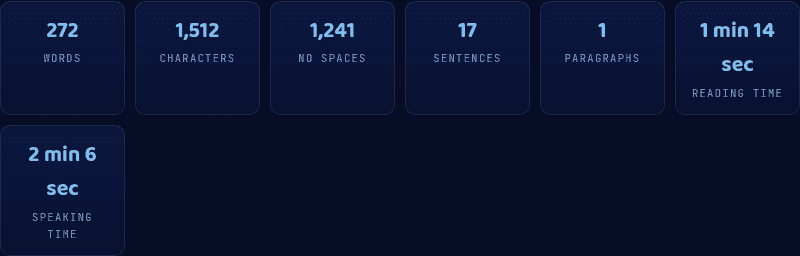
These conversions come up constantly: a form that caps input at a character count instead of a word count, a school assignment specified in pages instead of words, an abstract system with its own character limit. The screenshot above shows the actual ratio — a real 1,512-character sample paragraph comes out to 272 words, right in the expected range, which is a more reliable gut-check than any fixed multiplier.
The safest way to convert in either direction for your specific text — since the words-per-character and words-per-page ratios both shift with vocabulary and formatting — is to paste it into the counter below rather than trust a generic average.
Academic word counts
The Common App personal essay caps at 650 words, with 250 as the stated minimum — and admissions officers read thousands, so hitting 640 beats begging for 700. Supplemental essays typically run 150–350. A standard high-school essay assignment lands between 500 and 1,000 words; undergraduate papers usually run 1,500–5,000 depending on level; a master's thesis commonly spans 15,000–50,000; PhD dissertations 60,000–100,000.
The unwritten rule across all of it: word limits are tested at roughly ±10% tolerance, but going under reads better than going over. Nobody has ever been penalized for a tight, complete 600-word answer to a 650-word prompt.
Publishing and fiction
Trade publishers think in word counts, not pages. Flash fiction sits under 1,000 words; short stories 1,000–7,500; novelettes to about 17,500; novellas to about 40,000. Adult novels typically land between 70,000 and 100,000 words — debut manuscripts far outside that range face resistance regardless of quality. Young adult runs 50,000–80,000; middle grade 30,000–55,000; epic fantasy stretches past 120,000 with genre permission.
For pacing math: NaNoWriMo's 50,000-words-in-November target works out to 1,667 words a day, and a full 90,000-word novel at a sustainable 500 words a day is six months of drafting.
Platform limits: characters, not words
Platforms mostly cap characters. X: 280 for standard accounts. SMS: 160 characters per segment before your message splits. Instagram captions: 2,200 characters, truncated in feed after roughly 125. Instagram bio: 150. TikTok bio: 80. LinkedIn posts: 3,000 characters; YouTube titles: 100. For search visibility, Google displays about 60 characters of a title tag and truncates meta descriptions around 155–160 characters.
The catch when a form says "characters": does it count spaces? Most platform limits do, but some academic abstract systems don't — which is why a proper word counter shows characters both with and without spaces.
Emoji and styled Unicode complicate character counts further: platforms may count a single emoji as two characters (it occupies two UTF-16 units), and every combining mark in glitch text counts individually — one reason heavily-styled bios hit their limits far sooner than they appear to.
Blogging and SEO lengths
There's no magic ranking number, but patterns exist: pages that rank for competitive informational queries typically run 1,000–2,500 words, because depth correlates with covering what searchers need. Below ~300 words, pages risk being judged thin. The honest rule is completeness over count — a 700-word page that fully answers a narrow question outranks 2,000 words of padding. Word count is a proxy Google's systems have gotten steadily better at seeing through.
How reading and speaking time work
"4 min read" labels divide word count by an assumed reading speed. Adults read nonfiction silently at roughly 200–250 words per minute, so most tools pick a figure in that band — ours uses 220. Technical material reads slower; skimming reads faster; the label is a courtesy estimate, not a stopwatch.
Speaking is much slower: presenters average 120–150 words per minute. That gap is the classic speechwriting ambush — a "quick 5-minute talk" script should be only 600–750 words, and a 20-minute conference slot holds under 3,000. Draft to speaking time, not page count, and you'll stop getting cut off.
Tricks for hitting a word count honestly
Cutting is easier than it feels. Adverb sweeps ("very," "really," "actually") reclaim 2–5% of most drafts for free. Converting passive constructions to active voice shaves words while strengthening sentences. And most drafts open one paragraph before the actual beginning — deleting the throat-clearing intro is the single highest-yield cut in student writing.
Stretching is more dangerous, because padding is visible to every experienced reader. Instead of inflating sentences, add substance: a concrete example, a counterargument you address, a consequence you spell out. If a 650-word prompt defeats you at 400 words, the essay is missing an idea, not adjectives.
What actually counts as a word?
The standard rule — used by word processors and by our counter — is that any run of characters separated by whitespace is one word. So hyphenated compounds ("well-known") count once, numbers ("2026") count once, and "word counter" counts twice. Sentences are tallied from terminal punctuation, which means abbreviations like "Dr." can nudge the sentence count slightly high — treat it as a close estimate.
Our Word Counter tracks all of it live as you type or paste: words, characters with and without spaces, sentences, paragraphs, reading time, and speaking time — computed entirely in your browser, so drafts never leave your machine. For generating filler while you design, the Lorem Ipsum tool produces placeholder text to any target count.